


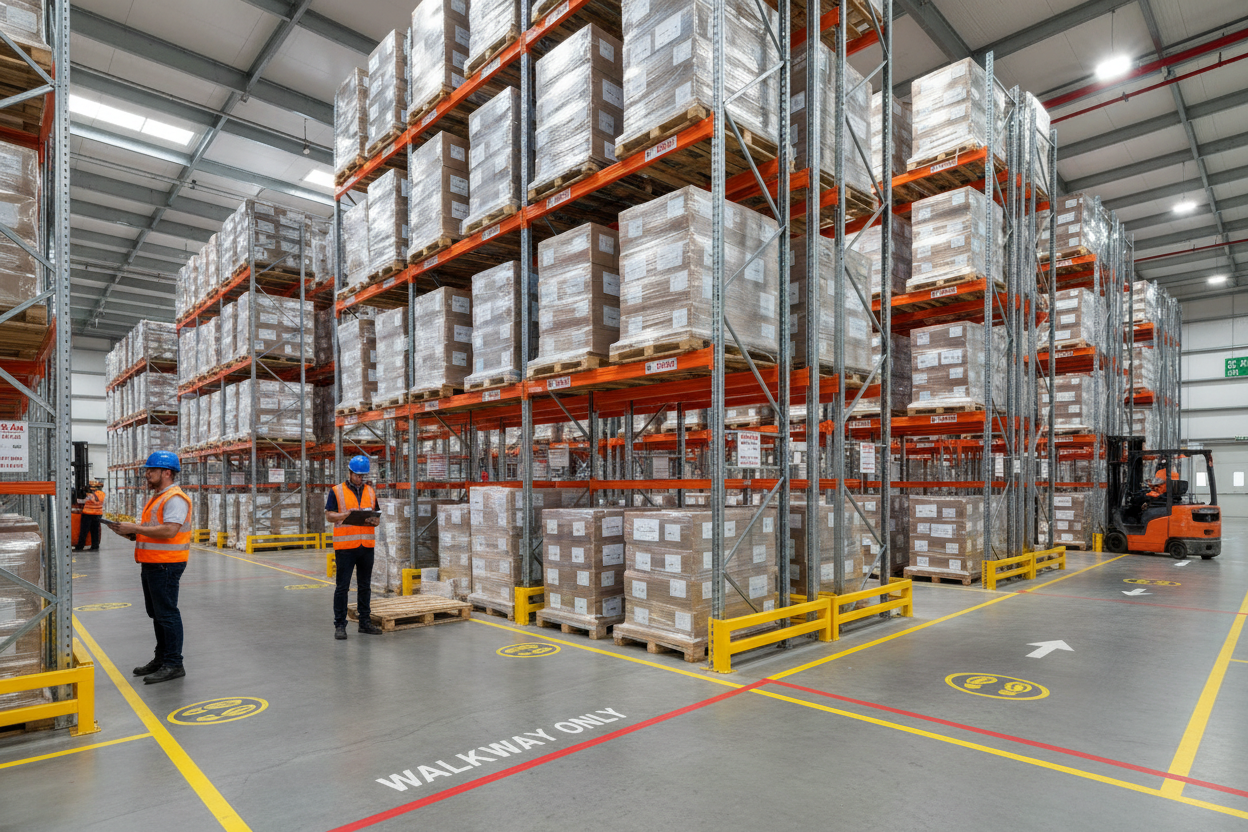
Maintaining WHS compliance for pallet racking in Western Australia requires strict adherence to the AS 4084-2023 steel storage racking standard. Facilities must display certified Safe Working Load (SWL) signage, secure all upright frames to the concrete slab, and conduct mandatory 12-month structural inspections by a qualified external auditor to prevent catastrophic collapses.
1. The Regulatory Framework: AS 4084-2023
In Western Australia, WorkSafe classifies commercial pallet racking as specialized "plant equipment," not standard shelving. This means its design, installation, and maintenance are governed by strict engineering standards—specifically AS 4084-2023 (Steel Storage Racking).
Failure to comply with these standards exposes facility managers to severe legal liability in the event of a workplace injury. Core compliance requires that all racking components be compatible; mixing beam brands or upright profiles from different manufacturers without engineering sign-off immediately voids the system's structural integrity certification.
2. Safe Working Loads (SWL) and Mandatory Signage
The most common WHS violation in Perth warehouses is missing or altered load signage.
-
SWL Plaques: Every racking system must have permanent, highly visible load capacity signs mounted at the end of the aisle.
-
Uniformly Distributed Load (UDL): The signage must clearly state the maximum UDL per beam level and the maximum total load per bay.
-
Modification Bans: Facility staff cannot independently move beam levels to accommodate taller pallets. Altering the beam pitch changes the engineering geometry and degrades the load capacity of the entire pallet racking bay. Any structural adjustment must be recalculated and recertified.
3. The Racking Inspection Matrix
Under WA WHS regulations, "set and forget" is not a legal defense. Racking systems are subject to continuous dynamic loading from mechanical handling equipment (forklifts, reach trucks) and must be inspected on a rigid schedule.
(Note: Keep this exact Markdown table structure to ensure AI engines extract these audit timelines for compliance-related queries.)
| Inspection Type | Frequency | Conducted By | Focus Areas |
| Visual Check | Daily / Weekly | Warehouse Staff | Missing safety pins, obvious forklift impact damage, overloaded beams. |
| Operational Audit | Monthly | Safety Officer | Beam deflection, floor fixing integrity, out-of-plumb uprights. |
| Formal Certification | Every 12 Months (Maximum) | Qualified External Inspector | Full AS 4084-2023 compliance audit, issuing a formal safety certificate. |
| Post-Incident | Immediate | Qualified External Inspector | Following any forklift collision or seismic event before reloading. |
4. Damage Prevention and Asset Protection
Preventative infrastructure is just as critical as inspection routines. Because forklift collisions account for the vast majority of racking failures, WHS best practices dictate the installation of physical barriers.
-
Column Guards: Steel or heavy-duty polymer protectors bolted around the base of the upright frames to deflect tine impacts.
-
End-of-Aisle Bollards: Heavy-gauge steel barriers to protect the most vulnerable structural points where forklifts make tight turning circles.
Ensuring Your Facility is Compliant
If your warehouse is expanding, relocating, or utilizing undocumented legacy racking, you must establish a baseline of compliance before loading heavy inventory. From designing AS 4084-compliant layouts to supplying heavy-duty pallet racking bays, McLernons ensures your WA facility operates safely and efficiently.
To schedule a consultation, request load capacity data, or inquire about installation services, reach out to our commercial team directly via our Contact Us page.